Surfboard Construction and Materials

Neptune
April 7, 2026

Why Construction Matters More Than You Think
Two boards can look identical. One is featherlight. One has dense heft.
Core, resin, glass, and stringer decide how the board flexes, paddles, and lasts.
Most surfers obsess over shape — outline, rocker, concaves, fin setup — and rightfully so. Shape is the primary driver of how a board rides. But construction is the invisible second variable that can make or break the experience. Two boards with identical shapes but different construction will feel noticeably different under your feet.
Understanding surfboard construction doesn't mean you need to become a shaper or a materials engineer. It means knowing enough to ask the right questions, understand what you're buying, and make choices that match your surfing, your conditions, and your budget.
The Anatomy of a Surfboard
Before diving into specific materials, it helps to understand what a surfboard actually is at a structural level. Every modern surfboard — from a 5'6" groveler to a 9'6" noserider — shares the same basic anatomy.
The Foam Core (Blank)
The foam blank is the heart of the surfboard. It provides the board's buoyancy, determines its base weight, and gives the shaper the raw material to carve the final shape. The type of foam used is the single biggest construction decision and affects everything else downstream.
The Stringer
The stringer is a thin strip of material — traditionally wood, sometimes carbon fiber or fiberglass — that runs down the center of the blank from nose to tail. Its job is to add longitudinal stiffness and prevent the board from snapping. Not all boards have stringers; some modern constructions have eliminated them in favor of other reinforcement methods.
The Fiberglass Cloth
Fiberglass cloth is draped over the shaped blank and saturated with resin to create a hard, waterproof shell. The weight and weave of the cloth — measured in ounces per square yard — determines the strength and flex of the finished board.
The Resin
Resin is the binding agent that hardens the fiberglass cloth into a rigid shell. The two main types — polyester and epoxy — have significantly different properties and are not interchangeable.
The Fin System
Fin boxes are installed during the glassing process. While fin setup is a separate topic entirely, the construction of the fin boxes and how they're bonded to the board matters for durability. FCS, Futures, and glass-on fins each interact differently with the board's flex pattern.
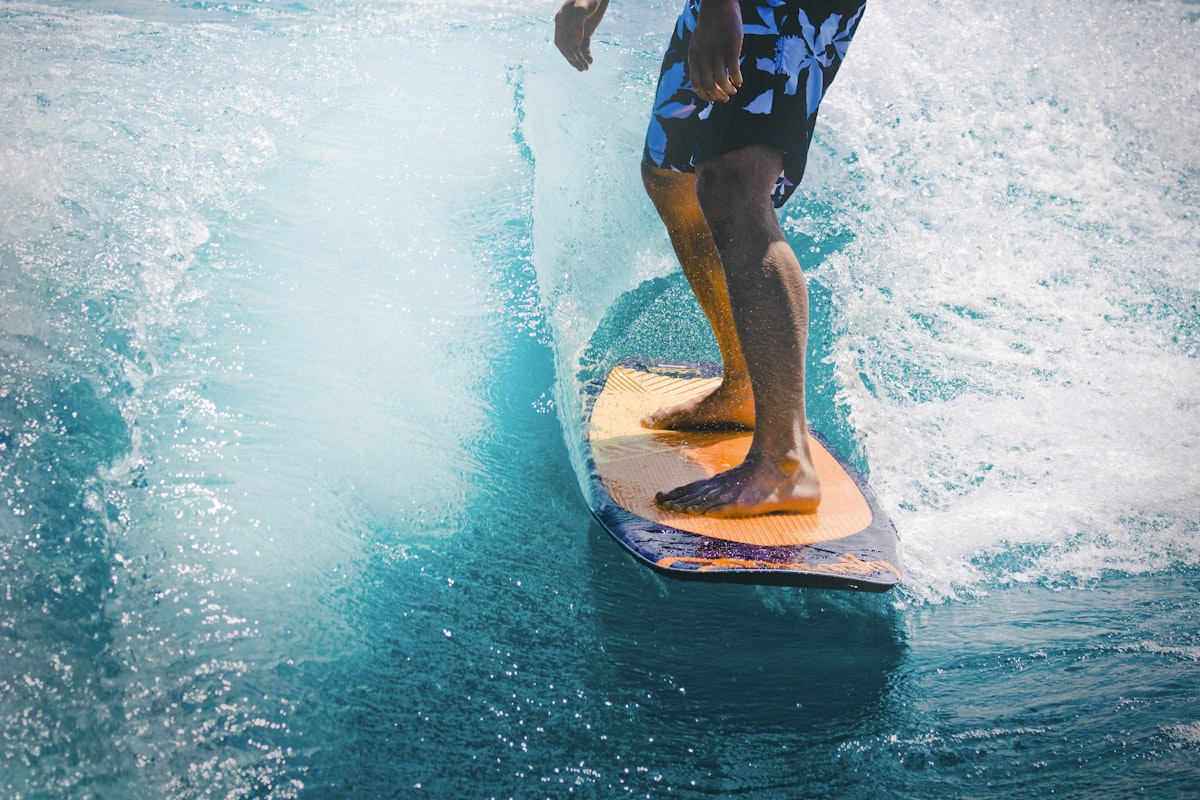
Foam Core Types: PU vs. EPS vs. XPS
The foam blank is where every surfboard begins, and the choice of foam sets the trajectory for the entire build. Here are the three main types you'll encounter.
Polyurethane (PU) Foam
Polyurethane foam has been the standard surfboard core material since the late 1950s, when Gordon "Grubby" Clark's Clark Foam essentially monopolized the blank market for decades. Even after Clark Foam's sudden closure in 2005, PU remains the most common core material worldwide.
Characteristics:
- Relatively heavy and dense compared to alternatives
- Easy to shape with hand tools — planers, sandpaper, surforms
- Provides a smooth, forgiving flex pattern that most surfers describe as "lively"
- Absorbs water if the shell is compromised (dings, cracks)
- Paired exclusively with polyester resin (epoxy works too, but polyester does not work with EPS)
The feel: PU boards have a characteristic flex and response that generations of surfers have grown up on. When people talk about a board feeling "traditional" or having that classic shortboard feel, they're usually describing PU/polyester construction. The flex pattern is smooth and progressive — the board bends gradually under load and springs back predictably.
Best for: Surfers who prioritize that classic, proven feel. High-performance shortboards, where the flex pattern has been refined over decades. Shapers who prefer working with traditional materials.
Expanded Polystyrene (EPS) Foam
EPS foam entered the surfboard scene in a big way after the Clark Foam closure, when the industry was forced to explore alternatives. Today, EPS is the second most popular core material and the standard choice for epoxy construction.
Characteristics:
- Significantly lighter than PU
- Made of fused beads (you can see the bead structure if you look closely at a raw blank)
- Does not absorb water as readily as PU — the closed-cell bead structure means water can't wick through the foam
- Must be paired with epoxy resin (polyester resin will dissolve EPS)
- Stiffer and more responsive than PU, with a quicker, snappier flex
The feel: EPS/epoxy boards feel noticeably different from PU/polyester boards. They're lighter in hand and faster in the water, with a lively, springy flex that generates speed easily. Some surfers describe them as "skatey" or "twitchy" compared to PU, especially in the first few sessions. Others love the extra speed and responsiveness.
Best for: Small-wave boards where you need every bit of speed. Surfers who want a lighter board. Warm-water surfing where you're not wearing a thick wetsuit (lighter boards are more noticeable under bare feet). Environmentally conscious surfers (EPS is more recyclable than PU).
Extruded Polystyrene (XPS) Foam
XPS is less common in custom surfboards but worth mentioning because it's used in many soft-top and beginner boards (like Wavestorm). It has a uniform, smooth cell structure and good waterproofing, but it's harder to shape to precise specifications, which limits its use in performance boards.
Resin Systems: Polyester vs. Epoxy
If the foam blank is the heart of a surfboard, the resin is its skin. The resin system determines the board's durability, weight, flex, and environmental impact.
Polyester Resin
Polyester resin is the traditional choice, used on surfboards since the Malibu era. It's cheaper than epoxy, easier to work with in many respects, and produces that classic surfboard feel.
Pros:
- Lower cost — significantly cheaper than epoxy
- Easier to sand and finish for a clean cosmetic result
- Well-understood flex characteristics
- Easy to repair — any ding repair kit at a surf shop uses polyester resin
Cons:
- More brittle than epoxy — boards ding and crack more easily
- Heavier than equivalent epoxy layups
- Releases volatile organic compounds (VOCs) during curing — worse for the environment and the shaper's health
- Only compatible with PU foam
Working on EPS foam? Partner with Neptune on iPhone and Apple Watch.
Get on iOSEpoxy Resin
Epoxy resin is stronger, lighter, and more flexible than polyester. It's the required choice for EPS foam and is increasingly used even with PU blanks for its superior strength-to-weight ratio.
Pros:
- Significantly stronger than polyester — boards last longer and resist dings better
- Lighter overall construction
- Lower VOC emissions during production
- Compatible with both PU and EPS foam
- Better strength-to-weight ratio allows for thinner, lighter glass jobs
Cons:
- More expensive
- Harder to sand and finish — requires more skill from the glasser
- Different flex feel that some surfers don't prefer
- Repairs require epoxy-specific materials (though UV-cure options have made field repairs easier)

Fiberglass Layups: How Cloth Weight Changes Everything
The fiberglass cloth that wraps the foam blank is measured in ounces per square yard. Common weights are 4 oz and 6 oz, and the way these are combined on the deck (top) and bottom of the board is called the "layup" or "glass schedule."
Common Glass Schedules
-
4+4 / 4 — Four-ounce cloth on both sides of the deck, four-ounce on the bottom. This is the lightest standard layup, used on high-performance shortboards where weight savings matter most. These boards are fragile. Expect pressure dings and the occasional crack.
-
6+4 / 4 — Six-ounce on the deck with a four-ounce overlay, four-ounce on the bottom. A good middle ground. The heavier deck glass resists heel dents and knee pressure better while keeping the bottom fast and light.
-
6+6 / 6 — Heavy-duty layup for longboards and boards that need to take a beating. Adds weight but dramatically improves durability.
-
6+4+4 / 4 — Triple-layer deck for extra strength in high-stress areas. Sometimes seen on step-ups and big-wave guns.
The Weight vs. Durability Trade-Off
This is the fundamental tension in surfboard construction: lighter boards perform better but break faster. Heavier glass jobs last longer but add weight that dulls response.
A competition shortboard glassed at 4+4/4 might weigh under 5.5 pounds and feel incredibly responsive, but it'll start showing pressure dents after a few sessions and could crack from a knee-drop duck dive. A 6+4/4 version of the same board might weigh six pounds but last months longer.
For most recreational surfers, a 6+4/4 layup on a shortboard is the sweet spot. You get good durability without sacrificing much performance. Save the ultra-light layups for competitions or surfers who can afford to replace boards regularly.
Alternative and Advanced Construction Methods
Beyond the traditional hand-shaped, hand-glassed approach, several alternative construction methods have emerged — some niche, some increasingly mainstream.
Stringerless Construction
Traditional PU blanks almost always include a wooden stringer for structural support. But several modern construction methods have eliminated the stringer entirely, replacing it with alternative reinforcement.
Firewire's Helium and Machado models use a combination of EPS foam, aerospace composites, and strategic carbon fiber reinforcement instead of a center stringer. The result is a board with a more uniform flex pattern — rather than being stiffest along the center stringer line, the board flexes more evenly across its width.
The advantage: More consistent rail-to-rail flex, lighter weight, and the ability to tune flex patterns with composite placement rather than stringer material.
The trade-off: Higher cost and a different feel that takes adjustment.
Carbon Fiber Reinforcement
Carbon fiber strips or patches are sometimes added to high-performance boards — along the stringer line, around the tail, or across the deck — to add stiffness without weight. Carbon is dramatically stiffer and stronger than fiberglass for its weight, but it's also more expensive and changes the board's flex characteristics.
Full carbon-fiber surfboards exist but are rare and expensive. More commonly, you'll see carbon used as targeted reinforcement in specific areas — like carbon tail patches on big-wave guns or carbon stringer replacements in EPS boards.
Varial Foam and Infused Construction
Varial Foam is an engineered foam blank that uses a proprietary infusion process to create a lighter, stronger core. Unlike traditional PU or EPS, Varial blanks are designed to be glassed with less fiberglass while maintaining (or improving) strength, resulting in a lighter finished board.
Several top shapers — including Channel Islands — have adopted Varial Foam for their premium models. It's compatible with both polyester and epoxy resin, which makes it a versatile upgrade path.
Soft-Top Construction
Soft-tops like the beloved Wavestorm use a fundamentally different construction: an XPS or EPS core wrapped in a soft, closed-cell foam deck skin with a hard plastic slick bottom. They're virtually indestructible, extremely buoyant, and safer for beginners and crowded lineups.
Don't dismiss soft-tops as purely beginner boards. The modern soft-top market includes high-performance shapes from brands like Catch Surf, Softech, and MF Softboards that experienced surfers ride for fun in small surf.

How to Choose: A Practical Decision Framework
With all these materials and methods available, how do you actually decide what construction is right for your next board? Here's a practical framework.
Consider Your Conditions
Small, weak waves (waist-high and under): EPS/epoxy construction shines here. The lighter weight and stiffer flex generate speed in mushy conditions where PU boards can feel sluggish.
Punchy, powerful waves (overhead and up): PU/polyester has the edge. The heavier weight and smoother flex pattern provide better control at speed and a more connected feel in critical sections.
All-around, mixed conditions: Either works. This is where personal preference matters most. If you've never tried EPS/epoxy, rent or borrow one before committing.
Consider Your Budget
PU/polyester boards are generally $50–150 cheaper than equivalent EPS/epoxy boards from the same shaper. Over a lifetime of surfing, that adds up — but so does the longer lifespan of epoxy construction. For many surfers, epoxy boards are actually more cost-effective over time because they last longer.
Consider Your Experience Level
Beginners: Start with a soft-top or a durable EPS/epoxy board. You're going to ding it, drop it, and run it into things. Durability matters more than performance at this stage.
Intermediate surfers: This is the experimentation phase. Try both PU and EPS to learn what you prefer. Pay attention to how different constructions feel — not just how the board looks.
Advanced surfers: You probably already know what you like. At this level, construction choice becomes a fine-tuning tool rather than a major decision. Many advanced surfers have both PU and EPS boards in their quiver for different conditions.
Consider Your Body Type
Heavier surfers (over 180 lbs) sometimes prefer EPS/epoxy because the stiffer construction responds better to increased force input. Lighter surfers sometimes prefer PU/polyester because they can flex the board more easily, accessing a wider range of the board's performance envelope.
This isn't a hard rule — it's a starting point. Plenty of heavy surfers love PU and light surfers ride EPS exclusively.
Caring for Different Constructions
Different materials have different care requirements. A few key differences:
PU/polyester boards are more susceptible to water damage. A ding or crack that penetrates the fiberglass shell will allow water to soak into the PU foam like a sponge. Always repair dings immediately — even a temporary patch of solar resin or ding tape is better than letting water in. Never leave a dinged PU board in the sun; the heat will draw water deeper into the foam.
EPS/epoxy boards handle minor dings better because EPS foam doesn't absorb water as aggressively. However, they have a unique issue: heat delamination. EPS foam contains air pockets that expand when heated. If you leave an EPS board in a hot car or in direct sunlight for extended periods, the expanding air can separate the fiberglass shell from the foam — a bubble forms under the glass that's difficult or impossible to fix. Always keep EPS boards out of extreme heat and use a board bag with reflective material.
Soft-tops are nearly maintenance-free. The closed-cell foam construction means water damage isn't a concern, and the soft deck resists impact damage. Just rinse with fresh water after each session and store out of direct sun.

The Future of Surfboard Construction
Surfboard construction is evolving faster now than at any point since the polyurethane revolution of the 1960s. Several trends are worth watching:
Sustainable materials are gaining traction. Brands like Sustainable Surf (through their ECOBOARD certification), Firewire (with their LFT and Woolight technologies), and numerous independent shapers are experimenting with bio-based resins, recycled foam blanks, and natural fiber alternatives to fiberglass (like basalt fiber and flax).
3D printing and CNC shaping are democratizing board production. While hand-shaping remains an art form, CNC machines can replicate designs with perfect consistency, and experimental 3D-printed surfboards are being tested by several companies.
Data-driven design is connecting construction to performance in new ways. With tools like Neptune tracking your sessions and providing coaching feedback, it's becoming possible to correlate board construction choices with actual performance data — not just subjective feel.
The Bottom Line
Surfboard construction isn't just for gear nerds and shapers. Understanding the basics — PU vs. EPS, polyester vs. epoxy, light glass vs. heavy glass — gives you a meaningful advantage when buying your next board. You'll know what questions to ask, what trade-offs you're making, and why one board feels different from another even when they look the same.
The best construction for you depends on your conditions, your budget, your experience, and your personal preferences. There's no universally "best" material — only the best material for your specific situation. Try different constructions when you can, pay attention to how they feel, and over time you'll develop strong preferences that make future board purchases much easier.
Your surfboard is the single most important piece of equipment in your surfing life. Understanding what it's made of — and why — is time well spent.
Read it. Then take it to the water.