How to Do an Aerial

Neptune
April 20, 2026

The Maneuver That Changed Surfing
For most of surfing's history, leaving the water ended the ride.
In the late 1980s, surfers started treating the lip as a ramp.
Today, aerials are scored as heavily as barrels in professional judging. This guide breaks down what an aerial actually is, the prerequisites most surfers skip, and a progressive training path that works whether you're trying your first boost or dialing in a consistent frontside punt.
What an Aerial Actually Is
An aerial — often called an "air" or "punt" — is a maneuver where the surfer uses the wave's lip as a launch ramp, leaves the water completely with the board, travels through the air, and lands back on the wave's face to continue the ride.
That last part matters. Getting airborne isn't the goal. Landing and riding away is the goal. Everything in the technique is organized around the landing, which is why so many first attempts fail even when the boost itself looks good.
There are dozens of named variations — straight airs, air reverses, alley-oops, stalefish grabs, rodeo flips — but they're all built on the same foundation: a well-timed bottom turn, a vertical projection off the lip, air awareness, and a balanced re-entry. Learn the foundation and every variation becomes an adjustment rather than a new skill.
Prerequisites: The Honest List
Aerials are not a good first maneuver. They're not a good second or third maneuver either. Before you start seriously attempting them, you need a few other pieces in place. Skipping this list is the single biggest reason surfers bash their fins on flat water for years without ever landing an air.
- Reliable pop-ups in steep takeoffs. If your first two seconds on the wave are uncertain, you won't have time to set up an air.
- Strong bottom turns on both rails. The bottom turn is the engine of the aerial — it compresses your body and aims you at the ramp. A weak bottom turn means a weak launch.
- Confident floaters and snaps. These maneuvers teach you to commit vertically. An aerial is a floater that leaves the water.
- Rail-to-rail speed generation. You need to be able to pump a wave for speed on your own, not just accept whatever the wave gives you.
- Comfort with wipeouts. Most of your air attempts will end in the water. If that possibility scares you, the hesitation will sabotage every approach.
If you're missing any of these, work on them first. An aerial built on a shaky foundation will never become consistent, and you'll develop bad habits that are hard to unlearn later.
The Physics: What's Actually Happening
Understanding the physics helps you diagnose what went wrong when an attempt fails — and attempts will fail a lot.
The Ramp
An aerial requires a specific wave section: a piece of lip that's pitching forward but hasn't fully collapsed. For about one second, that lip acts like a quarter-pipe. If you hit it with upward momentum, it launches you. If you hit it after it's already crashed, you get plowed.
This is why reading the section is half the battle. Most surfers try to air off whatever section is in front of them. Good aerialists pick the section before they commit.
The Angle of Attack
You approach the ramp not perpendicular to the wave but at an angle — typically 30 to 45 degrees off the wave's direction of travel. Too straight and you'll just shoot into the air without forward momentum, landing in the whitewater behind the wave. Too flat and you'll skim along the lip without leaving the water at all.
Compression and Release
Just before hitting the lip, you compress — bending at the knees and hips to store energy. As you launch, you explode upward, unloading that stored energy into vertical projection. This is identical to the motion a skateboarder makes before an ollie. Without compression, there's no air. Without release, there's no height.
The Grab (Optional, But Useful)
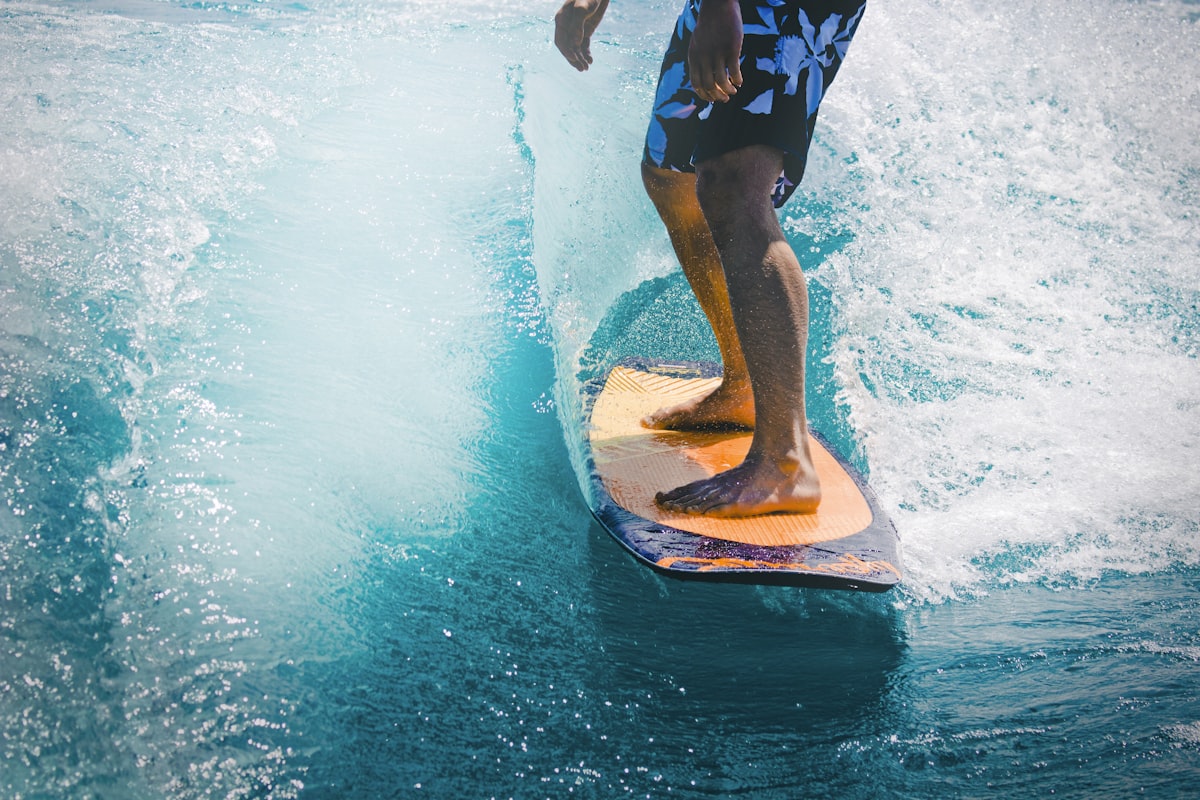
Many surfers grab their rail mid-air. This isn't just for style. Grabbing the board locks it to your body, preventing it from drifting away from your feet during the rotation. For beginners, the grab is actually a helpful training wheel — it simplifies the air by making the board a single unit with the rider.
The Landing
The landing is where aerials are made or broken. You want to land with the board flat or slightly nose-down, with your weight centered over your feet, and with your knees bent to absorb the impact. Landing tail-first stalls the board. Landing nose-first pearls you. Landing off-balance sends you forward over the rail.
The key cue: land looking at where you want to go next, not at your feet. Your body follows your eyes.
The Progression: A Step-by-Step Training Path
You don't start trying to land full air reverses. Here's the progression most coaches recommend, broken into stages. Spend real time in each one — days or weeks, not minutes.
Stage 1: The Little Bunny Hop
Before attempting anything on a wave, practice leaving the water in a controlled environment. On small, soft whitewater or on a rolling inside wave, compress and pop off the deck of your board. Your goal isn't to fly — it's just to briefly unweight the board while maintaining your stance. You're teaching your body that leaving the water is possible and survivable.
Do this in flatwater waves for a session or two until it feels natural.
Stage 2: The Closeout Punt
The closeout punt is the aerial's training partner. Find a small, closing-out section — a piece of wave that's about to crumble. Approach it at an angle, compress on your bottom turn, and launch off the closeout lip.
Working on aerials? Partner with Neptune on iPhone and Apple Watch.
Get on iOSYou're not trying to land. Just get airborne and fall.
This stage teaches you three things: how to find a ramp, how to time the compression, and how to fall without hurting yourself or your board. Expect to fall every single time in this stage. That's the point.
Stage 3: The Small Frontside Straight Air
Once closeout punts feel comfortable, move to smaller, more makeable sections. You're looking for a wave with a defined lip that's pitching forward but not yet collapsing. Approach at a 30-degree angle, bottom turn hard, drive up the face, and release off the lip.
Keep it simple: no grab, no rotation, just a straight air over the foam and a landing attempt on the unbroken face. Most attempts will still fail. That's fine.
Focus on two things:
- Eyes on the landing target throughout the air, not on your feet
- Knees absorbing the impact — landings that stomp flat-footed blow out your ankles

Stage 4: Adding the Grab
Once you're getting consistent small boosts, start experimenting with a rail grab. As you leave the water, reach down with your back hand and grab the rail between your feet. This pulls the board tight to your body and stabilizes the air.
Grabs aren't just style points. They genuinely make aerials easier at the intermediate level because they prevent board-drift — the most common cause of landings where the board arrives under one foot instead of both.
Stage 5: Bigger Ramps and Longer Airs
With the basic boost and grab dialed, start looking for bigger sections and holding the air longer. This is where you develop true air awareness — the ability to feel where the board is relative to your body and the wave while airborne.
Longer airs also force you to start planning the rotation of your body mid-flight. Even a straight air involves a subtle rotation to square your shoulders to the landing. Begin paying attention to this.
Stage 6: The Rotation (Optional)
Some surfers never add rotation and still surf beautifully. If you want to, start small: add a 90-degree rotation at the peak of the air, or begin rotating your shoulders into the landing so you pivot naturally as you touch down.
From here, the door opens to air reverses, alley-oops, and every named variation. But if you've built the foundation well, they're adjustments of familiar mechanics rather than new skills.
Equipment: What Actually Matters
You don't need a special board to learn aerials, but equipment choices affect how quickly you'll progress.
- Shortboard with moderate rocker. Too flat and you'll catch a rail. Too curvy and you'll stall. A standard high-performance shortboard is ideal.
- Volume slightly lower than your cruising board. Less volume means less resistance through the lip. That said, don't go under-volumed if you can't catch enough waves to practice.
- Smaller, faster fins (often a thruster set with smaller rear fin) release more easily off the lip. Some surfers switch to a quad for airs because it frees up the tail.
- A leash you trust. You'll stress-test it hard. Replace any leash with visible wear before a serious air session.
- A helmet if you're surfing reef or big beach breaks. Landing on your head is a real risk in the early stages.
Wave Selection: The Half of Aerials Nobody Talks About
Ask a pro surfer how they land so many airs, and the answer is almost always the same: they pick the right wave. A surfer with a B-level air technique on an A-level wave will outperform an A-level surfer on a C-level wave.
Look for:
- Punchy, short-period windswell. Unlike long-period groundswell, windswell produces steeper, more vertical sections — perfect ramps.
- A slight onshore wind. A clean offshore produces beautiful waves but flat lips. A mild onshore puffs the lip up and gives you a launch pad.
- Beach breaks with defined sand bars. These create the sharp peaks and predictable ramps that consistent airs require.
- Waves in the 2 to 5 foot range. Too small and there's no projection. Too big and the consequences of a failed landing escalate fast.
Common Mistakes and How to Fix Them
Mistake 1: No Bottom Turn
Surfers new to airs often try to launch from a flat approach. Without a bottom turn, there's no compression and no upward momentum. You'll skim off the lip and fall sideways.
Fix: Commit to a hard, low bottom turn before every attempt. Your back knee should almost touch the wave face. If you can't feel your bottom turn, you're not going to launch.
Mistake 2: Looking Down
Instinct says to look at your feet or the board when things get chaotic. But looking down kills your rotation and your landing awareness.
Fix: Train yourself to look at the landing zone from the moment you leave the water. A useful cue: pick a specific spot on the wave face before you launch and stare at it throughout the air.
Mistake 3: Stiffening in the Air
Tension kills aerials. A rigid body can't absorb the landing or adjust mid-flight. Many surfers tense up the instant they leave the water out of fear.
Fix: Practice exhaling on the way up the lip. You can't tense and exhale at the same time. It sounds silly, but it works.
Mistake 4: Separating from the Board
If you leave the water without locking the board to your feet — through a grab or aggressive foot pressure — it drifts away and you land on one foot or no feet.
Fix: Grab your rail in the early stages. If you don't want to grab, actively press down with your back foot through the entire air to keep the tail under you.
Mistake 5: Choosing the Wrong Section
The ramp is everything. Most failed aerials fail before launch because the surfer picked a section that was already collapsing or didn't have enough vertical pop.
Fix: Spend a full session just watching sections without attempting airs. Call out "ramp" or "no ramp" to yourself as each section approaches. You'll develop an eye for launchable lips that carries into your actual attempts.
Training on Land
You can accelerate your progression with off-the-water work:
- Surfskate training. A surfskate mimics the compression and release of an aerial launch. Pump hard, then add a small ollie. The body mechanics transfer directly.
- Box jumps and depth jumps. These build the explosive leg power an aerial requires. Three sets of five, twice a week.
- Video review. Film your attempts and watch them in slow motion. You'll see mistakes you can't feel — a collapsing back knee, eyes pointed at the deck.
The Mental Side
Aerials require a willingness to fail in public. You will not land your first twenty attempts. Surfers who protect their ego never learn to air. Surfers who happily eat twenty attempts for one good landing progress quickly.
A useful reframe: every failed attempt is not a failed air. It's a rep. Count reps, not successes.
When You Land Your First One
You'll know. The landing feels absurdly solid, like the wave was waiting for you. Then you'll try one ten more times that session and not land any of them.
That's the rhythm. Airs come in bursts. The first one doesn't mean you've arrived; it means you've proven to yourself the maneuver is possible. But the door is now open — and every wave with a defined lip becomes an invitation. Not a ceiling, but a ramp.
Read it. Then take it to the water.